Semantic Mappings Enable Automated Assembly
Data and knowledge originating from heterogeneous sources often use heterogeneous controlled vocabularies and/or ontologies for annotating named entities. Semantic mappings are essential towards resolving these discrepancies and integrating in a coherent way. This post highlights how this looks in two scenarios: when constructing a knowledge graph for graph machine learning and when constructing a comprehensive lexica for natural language processing, text mining, and curation.
Background
Data and knowledge integration are challenging because there exist many controlled vocabularies, ontologies, taxonomies, thesauri, classifications, and other resources that mint identifiers with some degree of conceptual overlap, redundancies, and discrepancies.
Problem Statement
When integrating data and knowledge from heterogeneous sources that refer to the same concepts using different identifiers, we get non-trivial duplications and missing connections in our results.
For example, if we constructed a knowledge graph by combining the Comparative Toxicogenomics Database (CTD) and the Monarch Disease Ontology (MONDO), we would get disconnected mechanisms describing how sapropterin is used to treat phenylketonuria because the CTD uses the Medical Subject Headings (MeSH) to describe genes/proteins and MONDO uses the HUGO Gene Nomenclature Committee (HGNC).
flowchart LR
    a["sapropterin (mesh:C003402)"] -- activates --> b["Phenylalanine Hydroxylase (mesh:D010651)"]
    c["phenylalanine hydroxylase (HGNC:8582)"] -- decreases --> d["phenylketonuria (MONDO:0009861)"]
    b -...-|missing connection, these should be collapsed together| c
As a consequence, these redundancies lead to inaccurate results, for example, when making queries between drugs and diseases or when using machine learning algorithms to make predictions for new edges.
Causes
I roughly classify these redundancies into three bins (from left to right in the figure): similar domain, hierarchically related domain, and non-specific to a domain. Below, I’ll give some concrete examples from the life sciences to illustrate.
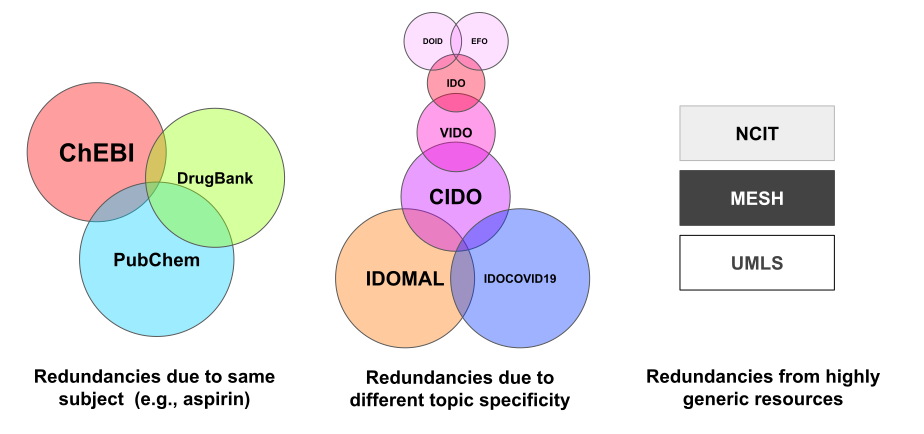
In chemistry, there are dozens of resources that assign identifiers to small molecules. Many have been constructed with unique scope or purpose such as MetaboLights for metabolites, SwissLipids for lipids, DrugBank for drugs. Some have similar scope and purpose, but have been constructed in parallel due to scientific modeling reasons, such as different disease ontologies modeling diseases with different parts of the Basic Formal Ontology (BFO). Some have similar scope and purpose, but have been constructed in parallel due to non-scientific reasons, such as PubChem and ChEMBL for small molecules with assay information. As an aside, building resources in an open and collaborative manner can help reduce proliferation, with the (major) caveat that they don’t satisfy funding bodies nor the requirements for career progression so easily.
In medicine and epidemiology, there are many resources describing diseases, transmission, response, adverse outcomes, and other facets. Particularly during the COVID-19 pandemic, many independent controlled vocabularies were constructed to model information at various levels of specificity. The figure shows the hierarchical relationships between the Disease Ontology (DOID), the Infectious Disease Ontology (IDO), the Viral Infectious Disease Ontology (VIDO), the Coronavirus Infectious Disease Ontology (CIDO), and the COVID-19 Infectious Disease Ontology (IDOCOVID19). When effectively reusing terms (as OBO Foundry Ontologies often do), this doesn’t create an issue, but in practice, many resources do not reuse terms for various reasons.
In the life sciences, there are several controlled vocabularies that cover a large number of domains such as the Medical Subject Headings (MeSH), National Cancer Institute Thesaurus (NCIT), and Unified Medical Language System (UMLS). While they give good coverage across many domains, these resources are often neither detailed, precise enough, nor curated as ontologies. Therefore, many controlled vocabularies use terms from these resources as a base and curate further. However, this causes redundancy, and in many cases, the group does not correctly cross-reference back. The Ontology for MicroRNA Target (OMIT) even imported the entirety of MeSH, but didn’t make any cross-references back to the source, creating even more redundancy.
If you were wondering why for each domain, we couldn’t just have a single resource, then please have a look at https://xkcd.com/927 :) Though, some resources that have been around for a long time basically have a monopoly. For example, nobody in their right mind in 2026 would start their own protein database to compete with UniProt.
Assembly
I want to highlight two groups for whom resolving redundancy has a high impact, but not necessarily high visibility. The first group is data scientists who consume knowledge graphs, for example, for graph machine learning. This group is often unaware of how graphs were constructed (see: any graph machine learning literature since 2013 that blindly uses FB15k and WN18).
The second group is curators, who want to use a combination of terminology services like the Ontology Lookup Service (OLS) and text mining tools to annotate the literature with controlled vocabulary terms. Curators don’t want to (and shouldn’t have to) understand the landscape of related controlled vocabularies for their domain and should just be responsible with terminology services and text mining tools to find any appropriate term for their curation.
The important point is that software should solve the problem of redundancy, and it needs to do so by consuming semantic mappings that bridge the gap illustrated above in the phenylketonuria example.
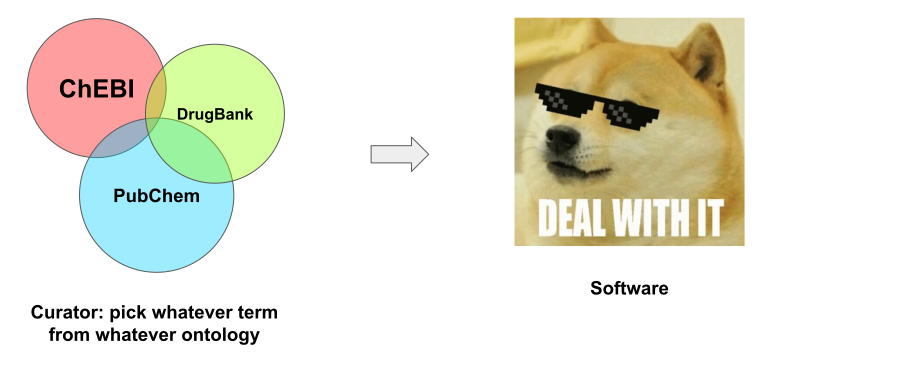
This leads to the main goal of the post, which is to describe two high-level workflows that can resolve redundancies and discrepancies when integration data and knowledge by using semantic mappings. This post isn’t about where semantic mappings come from - see my other posts on SSSOM, JSKOS, and SeMRA for more background on that.
Knowledge Graph Assembly
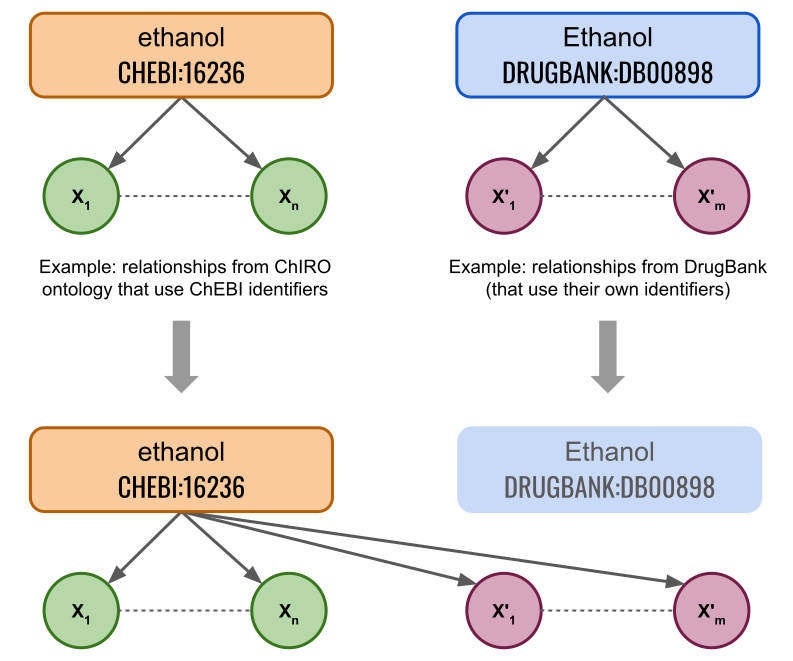
Resolving redundancies when constructing a knowledge graph means standardizing
the subjects, predicates, and objects in triples. For example, if we have
knowledge about ethanol from multiple sources and some identify it using the
ChEBI identifier 16236 while others identify it using the DrugBank identifier
DB000898, we will have a similar issue to the phenylketonuria approach. If we
have semantic mappings that denote CHEBI:16236 and drugbank:DB000898 are
equivalent, as well as the ruleset that ChEBI identifiers take precedent over
DrugBank identifiers, then we can map the triples from the resource that uses
DrugBank like described in the figure below:
Let’s take the ChEBI Ontology and DrugBank pharmacological data as two examples
that both annotate chemical roles. Here are a few scenarios for a given DrugBank
entry (assuming they both use the same rdfs:subClassOf relationship):
- There are no semantic mappings linking it to a ChEBI entry. In this case, the subject doesn’t need to be mapped.
- There is a semantic mapping linking it to a ChEBI entry, but there’s no semantic mapping linking the object to a ChEBI entry. For example, DrugBank annotates ethanol as Agents Causing Muscle Toxicity (drugbank.category:DBCAT003935). Therefore, the subject is mapped but the object is retained.
- There is a semantic mapping linking it to a CheBI entry and a semantic mapping linking the object to the ChEBI entry. For example, ChEBI annotates ethanol as a NMDA receptor antagonist (CHEBI:60643) and DrugBank annotates ethanol as a NMDA Receptor Antagonists (drugbank.category:DBCAT002723). In this case, the DrugBank triple is fully a duplicate of the ChEBI one. However, it may have valuable metadata to keep.
As another example, DrugBank annotates ethanol as a Cytochrome P-450 CYP3A4 Inhibitors (drugbank.category:DBCAT003232). There’s a corresponding term in ChEBI EC 1.14.13.97 (taurochenodeoxycholate 6α-hydroxylase) inhibitor, (CHEBI:86501), but there isn’t a semantic mapping capturing this. This is a job for the SSSOM Curator software and a semantic mapping repository like Biomappings to store it.
There are many examples of manually constructed workflows that do this process. While these work (e.g., Hetionet was one of the best), they are brittle towards expansion to new datasets and mappings, and often hard to keep up-to-date. My goal has been to implement a fully generic and automated version of this workflow, which I did as part of the Semantic Reasoner and Assembler. However, describing how it works on a technical level will be part of a future post.
Lexicon Assembly
Controlled vocabularies often contain labels and synonyms for their terms that are useful when constructing lexical indexes (i.e., databases of labels and synonyms) that can be fed into named entity recognition (NER) and named entity normalization (NEN) workflows - crucial components of natural language processing and text mining workflows that are commonly used by curators to annotate the literature with relationships that eventually become part of databases that are used to construct knowledge graphs.
However, much like knowledge, synonyms for the same concept might be spread over multiple different resources. Therefore, semantic mappings can be used to group multiple terms together and pool all of their synonyms, which both improves recall and reduces the number of duplicate groundings that might be given for a given part of text.
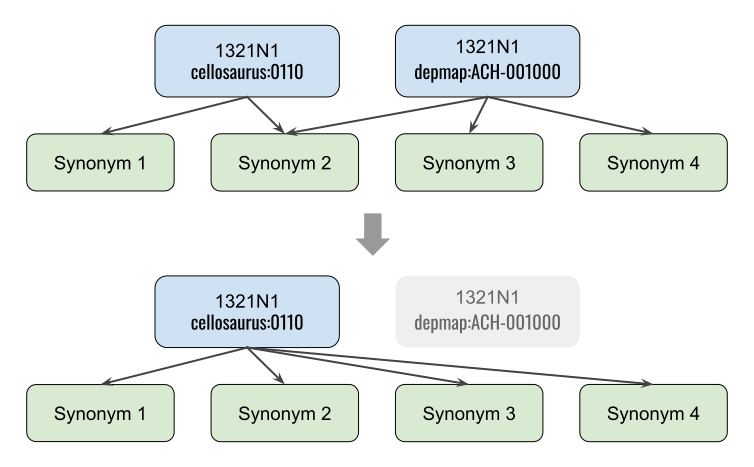
I’ve already made a technical implementation of this workflow in the Biolexica project, but I’m working towards generalizing and rebranding it for use outside the biomedical domain. I previously posted a simple demonstration using the underlying NER and NEN technology stack, but just using MeSH - a future post will show how this works with a coherent lexica for diseases, genes, and other entity types.