Discussions at the 7th NFDI4Chem Consortium Meeting
The 7th NFDI4Chem consortium meeting took place last week in Jena. This post is a summary of some of the interesting discussions I had there.
Ontologies and Mappings
I’ve been working on ontologies, semantic mappings, and knowledge graphs for nearly a decade. These interests fit well within NFDI4Chem TA4 and more generally within NFDI Section Metadata’s Working Group on Ontologies and Mappings. I want to highlight a few discussions I had about these topics at the 7th NFDI4Chem consortium meeting:
Ontology for Theoretical Chemistry
I discussed with Mario Wolter and Philip Strömert on how we could support Mario’s use case of making molecular dynamics and simulation experimental metadata more fair by constructing an ontology for theoretical chemistry.
The NFDI4Chem Ontologies Collection on the Semantic Farm (adapted from Ontologies4Chem: the landscape of ontologies in chemistry) lists the Computational Chemistry Ontology from the World Avatar project, but that resource is effectively unusable, motivating the curation of a new ontology (which when applicable can map back to the World Avatar ontology).
We plan to use the Ontology Development Kit (ODK) to begin work and will first focus on capturing basis sets used in computation. The ODK supports us in curating mappings to the World Avatar project’s ontology (when applicable) in the Simple Standard for Sharing Ontological Mappings (SSSOM). Interestingly, in the week since the conference, we identified parallel work in the NFDI on the Molecular Simulation Ontology (MOLSIM) which will need to be considered further.
Semantic Mappings for CHMO
In the weeks leading up to the consortium meeting, I have been discussing with Philip Strömert how to leverage SSSOM Curator to predict and curate semantic mappings between CHMO, FIX, REX, IUPAC OrangeBook, IUPAC GoldBook, and DAPHNE4NFDI’s PaNET ontology. While his HiWi made initial mappings between CHMO and GoldBook (among other exciting improvements) in NFDI4Chem/rsc-cmo#17, I was able to prepare mappings at scale between all resources using SSSOM Curator, then curate them relatively quickly (within a few hours) in nfdi-de/section-metadata-wg-onto#88 and nfdi-de/section-metadata-wg-onto#89. Philip and I coordinated next steps for the ontology agenda for NFDI4Chem (TA4), which will include porting several other chemistry ontologies to using the ODK (RXNO, CHEMINF) and to write manuscript describing how to produce ontology bridge files from the SSSOM semantic mapping curations.
Annotating Interfacial Electrochemistry Data
Albert Engstfeld presented
echemdb, a community project for interfacial
electrochemistry and local research data management. They recently ported their
data model to LinkML, but weren’t aware of how ontologies
could be used to annotate data. I discussed with him how their free-text
descriptions of electrode types could be replaced with references to terms in
the Chemical Methods Ontology (CHMO) under the
CHMO:0002344 (electrode)
hierarchy.
Immediately, Albert identified missing electrode terms from CHMO and places where the terms could be better organized. Luckily, NFDI4Chem is currently under the process of taking stewardship over CHMO and making a major update, so NFDI4Chem will be able to support and enable Albert to improve the ontology to better suit his data resource. In general, this shows the power of the open data, open code, open infrastructure (O3) mindset codified by the OBO Foundry Principles that influenced the original development of CHMO.
Knowledge Graphs and Graph Machine Learning
I discussed with Kenichi Endo and Felix Neubauer (U. Stuttgart) how to find ontologies to annotate their data describing reaction and process steps, and ultimately how these could be converted into knowledge graphs. I also discussed graph machine learning methods with them, particularly knowledge graph embedding models (KGEMs) and the PyKEEN graph machine learning library that I co-developed.
Better Ontological Communication
On the train ride home, I sat with Theo Bender and reflected on the discussions with Albert, Kenichi, and many others. Despite NFDI4Chem being a nexus of ontology expertise, it’s actually the case that many people don’t really know what they are, how to find relevant ontologies for their work, or how to use them. This is an opportunity for me to participate in TA5 to help improve the educational material NFDI4Chem has, and a call to give more (less technical talks) demonstrating the usage of ontologies in NFDI4Chem to motivate others to get excited (tracked in NFDI4Chem/knowledge_base#508). Further, this ties into discussions about Semantic Farm (see below) and how it’s a tool that can help NFDI4Chem consortium members find the right ontologies for their work.
Training Materials and DALIA
On the train ride home, I also discussed with Hans-Georg Weinig (GDCh, German Chemical Society) how NFDI4Chem could incorporate training materials from the German Chemical Society into DALIA, the NFDI’s search portal for training materials, as part of TA5.
Semantic Farm
The Semantic Farm (previously called the Bioregistry, now adapted to be domain-agnostic) is a registry of ontologies, controlled vocabularies, terminologies, and other resources that mint (persistent) identifiers. While it’s already been widely adopted in the biomedical domain since its creation in 2019 (e.g., by the OBO Foundry, Monarch Initiative), I’ve been working to integrate it within NFDI4Chem and other NFDI consortia via the NFDI Section Metadata Working Group for Ontology Harmonization and Mapping. I want to highlight a few discussions I had about the Semantic Farm at the 7th NFDI4Chem consortium meeting:
Extending Semantic Farm’s Provider Data Model
For each ontology, controlled vocabulary, terminology, and other resources that
mint (persistent) identifiers, the Semantic Farm keeps track of one or more
websites that can provide information about entities from that resource. For
example, there is a first-party provider for the Gene Ontology that shows
information terms like GO:0032571 (response to vitamin K). There are also many
third party providers such as through the EBI Ontology Lookup Service (OLS) and
Jackson Laboratories’ browser.
I talked with Steffen Neumann about extending the Semantic Farm’s data model for providers to include more information about:
- what media types (e.g., HTML, JSON, RDF) the provider returns by default
- whether content negotiation is possible by sending an
Acceptheader to tell the server which media type to return
Steffen’s use case in NFDI4Chem TA3/TA6 is the Semantic Farm entry for MassBank (https://semantic.farm/massbank). Enabling Semantic Farm to resolve in different ways will support the development of computational workflows as well as make it more useful when implementing the MassBank front-end.
Adding Semantic Web Interoperability to Semantic Farm’s Resolver
I talked with Egon Willighagen (a longtime collaborator of mine and a member of one of the NFDI4Chem advisory boards) about how to extend the “resolver” functionality of Semantic Farm to support content negotiation. The resolver redirects URLs constructed with a CURIE like https://semantic.farm/GO:0032571 to the first-party (or best) web page for human reading.
Egon suggested that if a request contains an Accept header asking for
text/turtle (or any other RDF-adjacent mimetype) that it could return the list
of related URIs. Importantly, this functionality is already available via the
API
(https://semantic.farm/api/reference/GO:0032571)
and on the front-end
(https://semantic.farm/reference/GO:0032571),
but not possible through the resolver endpoint.
In
biopragmatics/bioregistry#1954,
I extended the resolver so now it’s possible to use Accept headers like in the
following:
import requests

res = requests.get(
    "https://semantic.farm/GO:0032571",
    headers={"Accept": "text/turtle"},
)
I also added a way of adding query parameters to get the same results when
navigating to
https://semantic.farm/GO:0032571?format=turtle
(note the addition of ?format=turtle). For both, the following is returned:
@prefix rdfs: <http://www.w3.org/2000/01/rdf-schema#> .

<https://semantic.farm/GO:0032571> rdfs:seeAlso <http://bio2rdf.org/go:0032571>,
        <http://identifiers.org/obo.go/GO:0032571>,
        <http://purl.obolibrary.org/obo/GO_0032571>,
        <http://purl.org/obo/owl/GO#GO_0032571>,
        <http://www.geneontology.org/GO:0032571>,
        <http://www.informatics.jax.org/searches/GO.cgi?id=GO:0032571>,
        <http://www.informatics.jax.org/vocab/gene_ontology/GO:0032571>,
        <http://www.pantherdb.org/panther/category.do?categoryAcc=GO:0032571>,
        <https://bioportal.bioontology.org/ontologies/GO/?p=classes&conceptid=http://purl.obolibrary.org/obo/GO_0032571>,
        <https://identifiers.org/GO:0032571>,
        <https://n2t.net/go:0032571>,
        <https://www.ebi.ac.uk/QuickGO/GTerm?id=GO:0032571>,
        <https://www.ebi.ac.uk/QuickGO/term/GO:0032571>,
        <https://www.ebi.ac.uk/ols4/ontologies/go/terms?iri=http://purl.obolibrary.org/obo/GO_0032571>,
        <https://www.nextprot.org/term/GO:0032571> .
Semantic Farm and Base4NFDI
I’ve been working towards proposing the Semantic Farm as a Base4NFDI service (despite the recent announcement that Base4NFDI won’t be accepting any new proposals for funding). I discussed this with Martin Reinhardt and Hannah Butz from Base4NFDI at their poster (photo below borrowed from Martin’s post on LinkedIn).
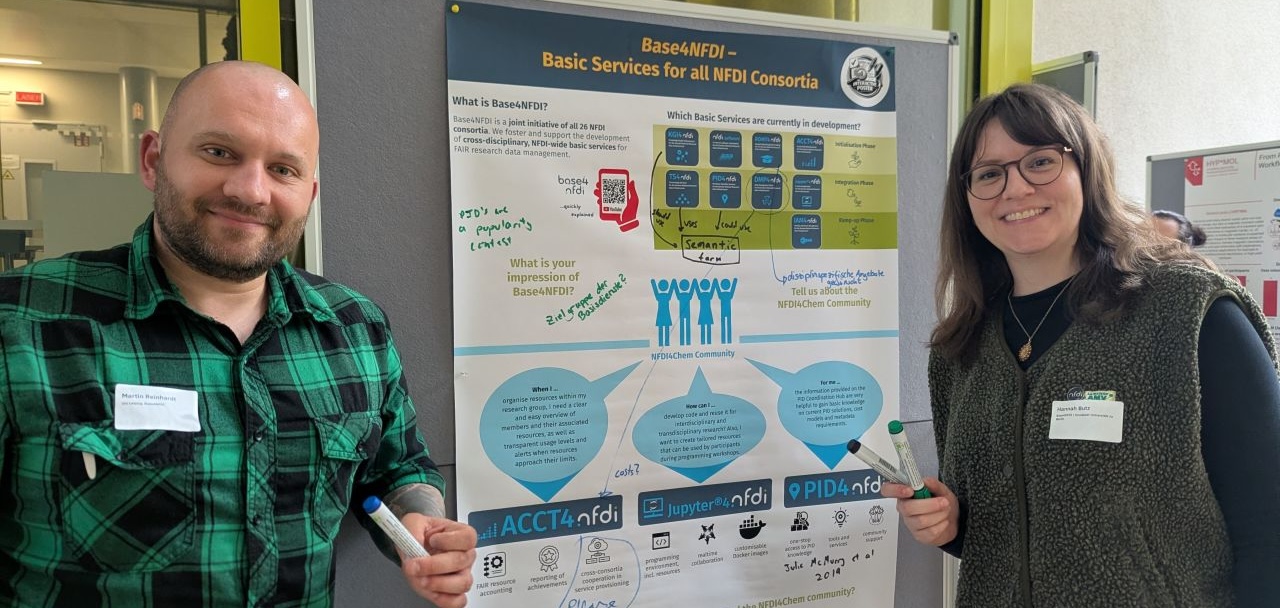
They had the exciting idea to encourage people to draw on their poster, so I added the relationships between TS4NFDI, KG4NFDI, and PID4NFDI and the Semantic Farm. It’s possible to see in the photo if you squint, but here’s the same arrows drawn again:
flowchart LR
    ts4nfdi[TS4NFDI] -->|already uses|sf[Semantic Farm]
    kgi4nfdi[KGI4NFDI] -->|should use|sf
    pid4nfdi[PID4NFDI] -->|could use|sf
We discussed how the Semantic Farm is already a key service as part of the TS4NFDI, how it should be adopted by KGI4NFDI (e.g., to make sure that all NFDI knowledge graphs use the same prefixes, CURIEs, and URIs for the same things), and how could fit in with PID4NFDI to support them in better communicating what identifiers do, where they come from, and how they make data FAIR beyond the limited number of identifier spaces (e.g., DOI, ORCiD, ROR, Handles) on which they currently focus. They also suggested I attend the Base4NFDI User Conference 2026 in Berlin to communicate these things further.
Chemotion
I’m currently leading the effort to develop a data infrastructure for the Catalaix project which will capture experimental information about polymerization and depolymerization reactions from both the literature and experiments in our laboratory. Our researchers are using Chemotion, so I discussed requirements for programmatically extracting data from Chemotion with Shashank Harivyasi (KIT), the Chemotion developer responsible for Chemotion’s API. I also discussed with Nicole Jung (KIT) our more general need to identify and reuse, or develop, an external standard for reaction information.
I’m a big fan of these meetings, especially because they are typically short and well-attended. While this post focused on bigger picture discussions, I also had lots of small talks with friends and collaborators like Kohulan and Chandu that were completely invaluable to making NFDI4Chem a great experience. I’m looking forward to our next big in-person meetup at Ontologies4Chem in Limburg in November!