Axiomatizing Atomic Numbers in ChEBI
This post describes how I produced a novel ontology module that axiomatizes the atomic numbers for ChEBI terms representing atoms (i.e., subclasses of CHEBI:33250) using subclass expressions with data restrictions, and the ROBOT template magic that made it possible.
Motivation
I am currently working in NFDI4Chem with Mario Wolter and Robin Ströhmann at TU Braunschweig towards developing an ontology for theoretical chemistry. Our first narrowly scoped module covers basis sets - sets of mathematical functions and their respective parametrization used to construct wave equations in computational chemistry experiments. Our initial approach is to extend the Basis Set Exchange, an existing comprehensive database of basis sets that could be made more valuable by ontologizing its contents.
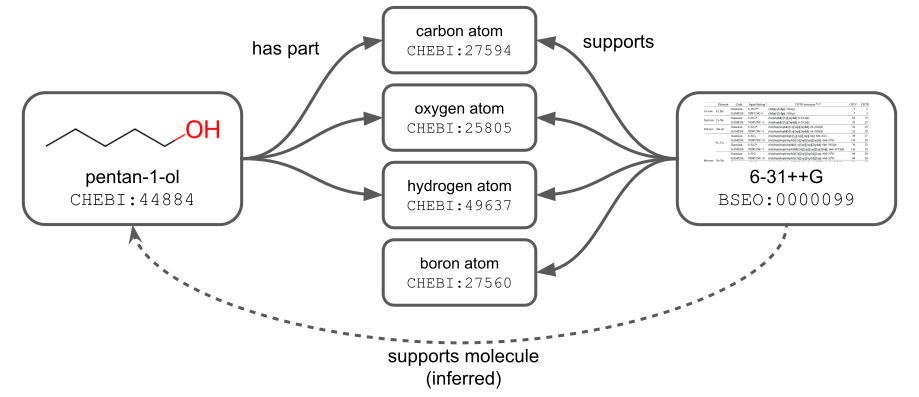
A key aspect of each basis set is to which elements it is applicable. While any general purpose programming language with a cheminformatics package could be used to parse a molecule from SMILES, InChI, Molfile, SDF, or other format then cross-check against the basis set metadata (see below), our goal is to enable an ontology reasoner to determine which basis sets are applicable to a molecule based on logical axioms connecting the molecule with the has part (BFO:0000051) relationship to a subclass of atom (CHEBI:33250).
Each basis set in the Basis Set Exchange can be downloaded as JSON from their API. For example, the 4-31G valence double-zeta basis set can be downloaded here and gives the following JSON (lightly edited and abridge for clarity, element values removed):
{
  "name": "4-31G",
  "family": "pople",
  "description": "4-31G valence double-zeta basis set",
  "role": "orbital",
  "elements": {
    "1": {},
    "2": {},
    "5": {},
    "6": {},
    "7": {},
    "8": {},
    "9": {},
    "10": {},
    "15": {},
    "16": {},
    "17": {}
  }
}
With this data, I am very close to being able to create axioms on my basis set
terms for which atoms they support. The issue with this data is that I don’t
have a mapping from the atomic numbers appearing as keys in the elements
dictionary to the ChEBI terms for each atom.
It turns out, that this information isn’t encoded in ChEBI at all! My natural reflex was to start curating and to start coding a solution. The resulting ontology module is available here.
How did I make it?
I started with a cursory search of ChEBI to understand the different senses in which atoms/elements are encoded - the atom hierarchy typically has the element name plus “atom” at the end, except in a few cases. I curated a dictionary mapping from atomic number to element name in Python then used PyOBO to look up ChEBI terms based on labels using the following (pseudo)code:
import pyobo
from pystow.utils import safe_open_writer

atomic_number_to_name = {
    1: "hydrogen",
    # and everything in between, omitted for brevity
    118: "oganesson",
}
grounder = pyobo.get_grounder("chebi")
with safe_open_writer("elements.tsv") as writer:
    writer.writerow(("ID", "TYPE", "label", "atomic number"))
    writer.writerow(("ID", "TYPE", "", "SC 'ChEMROF:atomic_number' value %"))
    for atomic_number, name in atomic_number_to_name.items():
        if match := grounder.get_best_match(f"{name} atom"):
            writer.writerow((match.curie, "class", match.name, atomic_number))
        elif match := grounder.get_best_match(name):
            # all nine of these cases were post-checked to be correct, see table below
            writer.writerow(
                (match.curie, "class - check/fix", match.name, atomic_number)
            )
        else:
            # this never happens, because ChEBI is comprehensive
            raise ValueError(f"no match available for {name}")
Along the way, I found nine elements that fell within the atom hierarchy but were named without the “atom” suffix. I also found that for aluminum and cesium that ChEBI only encoded the British spelling and not the American spelling, so these had to be post-curated by hand. I opened up an issue on the ChEBI repository summarizing the situation at ebi-chebi/ChEBI#4958:
| atomic number | ChEBI label | CURIE | Problem |
|---|---|---|---|
| 13 | Aluminium | CHEBI:28984 | missing american spelling variant, see ebi-chebi/ChEBI#4956 |
| 46 | Palladium | CHEBI:33363 | is in atom hierarchy, but name is missing suffix “atom” |
| 55 | Caesium | CHEBI:30514 | missing american spelling variant ebi-chebi/ChEBI#4957 |
| 58 | Cerium | CHEBI:33369 | is in atom hierarchy, but name is missing suffix “atom” |
| 68 | Erbium | CHEBI:33379 | is in atom hierarchy, but name is missing suffix “atom” |
| 70 | Ytterbium | CHEBI:33381 | is in atom hierarchy, but name is missing suffix “atom” |
| 78 | Platinum | CHEBI:33364 | is in atom hierarchy, but name is missing suffix “atom” |
| 90 | Thorium | CHEBI:33385 | is in atom hierarchy, but name is missing suffix “atom” |
| 100 | Fermium | CHEBI:33394 | is in atom hierarchy, but name is missing suffix “atom” |
| 102 | Nobelium | CHEBI:33396 | is in atom hierarchy, but name is missing suffix “atom” |
| 110 | Darmstadtium | CHEBI:33367 | is in atom hierarchy, but name is missing suffix “atom” |
How does this work?
The primary manually curated artifact in this repository (cthoyt/chebi-atomic-numbers-ontology) is elements.tsv, a tab-separated values (TSV) file that contains templating information in its header that directs ROBOT how to convert it into an ontology file.
The contents of the file look like this:
| ID | TYPE | label | atomic number |
|---|---|---|---|
| ID | TYPE | SC ‘ChEMROF:atomic_number’ value % | |
| CHEBI:49637 | class | hydrogen atom | 1 |
| CHEBI:30217 | class | helium atom | 2 |
| … | … | … | … |
| CHEBI:194539 | class | tennessine atom | 117 |
| CHEBI:194541 | class | oganesson atom | 118 |
Note that there are two header rows: the first contains labels and the second contains ROBOT template commands. Here’s what each means:
- The
IDcommand says that this column contains the CURIE for the entity we’re annotating. We writeIDin both the human label and the ROBOT command here to reduce confusion. TYPEsays what kind of entity it is and how it should get declared. Either an informal abbreviationclassor fully qualified CURIEowl:Classcan be used in this columnlabelhaving a label column is important to make this file human-readable, but it’s better to keep the output ontology module lean, so I didn’t add a ROBOT command.
If I had wanted to serialize these values, I could have used the ROBOT commandAT rdfs:label^^xsd:string.atomic numberthis is the coolest part of what’s going on in this file.SC 'ChEMROF:atomic_number' value %has four parts:SCmeans that this is going to be a subclass expressionChEMROF:atomic_numberis the data property from the Chemical Entity Materials and Reactions Ontological Framework (CHEMROF) used in the expression. Quotes around the CURIE are required!valuesignals it’s going to be a literal%is the placeholder for the value in each row
Because of the flexibility of the ROBOT templating language, this TSV can effectively be used as a normal TSV, e.g., to programmatically get the mapping from ChEBI identifiers to atomic numbers without going through OWL software.
In addition to keeping the ontology lean, omitting the labels also avoids the
issue where the labels in my curated resource might get out of sync with the
upstream ChEBI ontology. This is especially true because this work prompted me
to petition ChEBI to update some of these labels! A typical ontology workflow is
to have both a lean and a full export. In the full export, I can use the
robot extract command with the
MIREOT algorithm to pull in
all descendants of the ChEBI atom class and merge them in the build. This also
has the benefit of making the full export easier for humans to navigate, e.g.,
from Protégé.
How to make the ontology export
The usage of robot template is
encoded in the repository’s
justfile.
This does the following:
- Qualifies all prefixes used (CHEBI and ChEMROF)
- Merges a dedicate metadata ontology module
metadata.ofn - Adds declaration information for the data property that doesn’t appear in
entities.tsvthat is in a different ROBOT templateproperties.tsv
These can all be re-run with:
$ just convert
The results are OWL that look like this (shown in OFN for brevity):
SubClassOf(CHEBI:49637 DataHasValue(ChEMROF:atomic_number "1"^^xsd:integer))
SubClassOf(CHEBI:30217 DataHasValue(ChEMROF:atomic_number "2"^^xsd:integer))
...
SubClassOf(CHEBI:194539 DataHasValue(ChEMROF:atomic_number "117"^^xsd:integer))
SubClassOf(CHEBI:194541 DataHasValue(ChEMROF:atomic_number "118"^^xsd:integer))
While I put everything in a GitHub repository and archived it on Zenodo
 ,
I would love to see this get upstreamed to ChEBI itself. Now, I can get back to
the original goal of encoding the basis set information 🚀
,
I would love to see this get upstreamed to ChEBI itself. Now, I can get back to
the original goal of encoding the basis set information 🚀